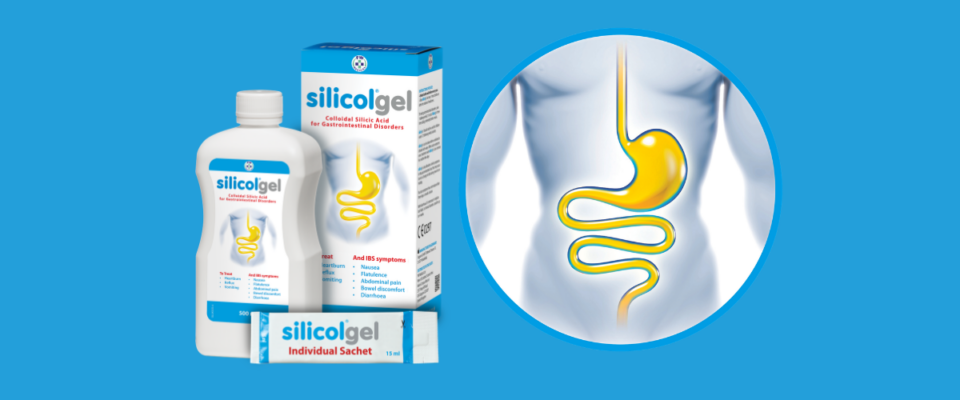
If you experience symptoms such as bloating, abdominal discomfort, diarrhoea, flatulence, nausea, heartburn or reflux, you may have wondered: “What is actually happening inside my gut?”
And more importantly, how can Silicolgel help?
Silicolgel works differently from many conventional medicines. Rather than being absorbed into the bloodstream, it works locally in the gastrointestinal tract. Its main ingredient, colloidal silicic acid, has a unique surface structure that allows it to physically bind substances that can contribute to digestive discomfort.
But what does that actually mean?
Let’s break it down.
What is Silicolgel?
Silicolgel is an oral gel containing colloidal silicic acid.
Silicic acid is a compound made from silicon and oxygen. In Silicolgel, it is present in a highly dispersed, hydrated form known as a colloidal gel.
The important part isn’t just what silicic acid is made of, it’s how its tiny particles behave inside your digestive system.
The particles have a very large and reactive surface area. This gives them the ability to adsorb and bind certain unwanted substances in the gastrointestinal tract.
So, how does Silicolgel actually work?
Think of Silicolgel as creating a protective, soothing layer over the lining of your stomach and intestines.
Once swallowed, the gel comes into contact with the gastrointestinal mucosa, the delicate lining of your digestive tract.
It spreads over this lining, forming a protective layer.
At the same time, the silicic acid particles act a little like a magnet.
Their large surface area allows them to physically attract, adsorb and bind substances such as irritants, toxins and pathogens that may be present in the gastrointestinal tract.
These substances are then carried through the digestive tract and naturally eliminated from the body.
A simple way to picture it:
Silicolgel → coats → binds → carries away
1. COATS
Silicolgel forms a protective layer over the gastrointestinal lining.
2. BINDS
Its tiny silicic acid particles physically adsorb and bind certain irritants, toxins and pathogens.
3. CARRIES AWAY
The bound substances pass naturally through the digestive system and are eliminated from the body.
This is known as a physical mode of action.
What does “adsorption” mean?
You may have heard the word absorption before, but Silicolgel works through adsorption with a “d”.
The difference is important.
Absorption means that a substance is taken into another substance, like a sponge soaking up water.
Adsorption means that substances attach to the surface of another material.
Silicolgel works through adsorption because its silicic acid particles have a very large surface area. This provides lots of space for certain substances to attach to the surface of the particles.
So, rather than being absorbed into your body, Silicolgel works on the surface of the gastrointestinal tract.
How can this help with digestive symptoms?
Digestive discomfort can involve several different factors, including excess acid, gas and substances that irritate the gastrointestinal tract.
Silicolgel’s physical mode of action can help in several ways.
It helps protect the gut lining
The gel forms a protective coating over the gastrointestinal mucosa, helping to soothe and protect the lining of the digestive tract.
It binds irritants and unwanted substances
The silicic acid particles can physically bind certain irritants, toxins and pathogens in the gastrointestinal tract, helping them pass naturally out of the body.
It can bind excess acid
Silicolgel can also bind excess acid in the stomach, which can help relieve symptoms such as heartburn and acid reflux.
It can bind gas
The particles also have gas-binding properties, which can help reduce flatulence and associated digestive discomfort.
Does Silicolgel get absorbed into the body?
No. Silicolgel is designed to work locally within the gastrointestinal tract.
Its action is physical: the silicic acid particles interact with substances on their surface rather than relying on the product being absorbed into the bloodstream.
Once the gastrointestinal tract naturally moves its contents along, the bound substances are carried through and eliminated from the body.
Why does Silicolgel have such a large surface area?
This is one of the most interesting things about Silicolgel.
Although you only take a relatively small amount of gel, the silicic acid particles have an extremely large combined surface area.
This large surface area is what gives the particles their high adsorption capacity.
In simple terms, think of it like this:
Small amount of gel ≠ small amount of surface area.
The tiny particles provide a huge amount of surface on which substances can attach.
This is what allows Silicolgel to work effectively through its physical mode of action.
Silicolgel and IBS symptoms
Irritable bowel syndrome (IBS) can cause a range of uncomfortable digestive symptoms, and symptoms can vary from person to person.
Silicolgel is used to help manage gastrointestinal symptoms associated with IBS, including:
- Abdominal pain and discomfort
- Diarrhoea
- Flatulence
- Nausea
- Bowel discomfort
It can also be used for gastrointestinal symptoms such as heartburn, reflux and vomiting.
The important thing to understand is that Silicolgel doesn’t need to enter your bloodstream to work. It acts directly where the discomfort occurs, inside your gastrointestinal tract.
The bottom line
So, how does Silicolgel work?
It works physically, inside your gastrointestinal tract.
After swallowing Silicolgel:
→ It coats the gastrointestinal lining
→ Its silicic acid particles bind certain irritants, toxins and pathogens
→ It can bind excess acid and gas
→ The bound substances are naturally carried out of the body
This unique combination of protective coating, adsorption and binding is what gives Silicolgel its mode of action.
Rather than simply masking digestive symptoms, Silicolgel works directly in the gastrointestinal tract through a physical process, helping to soothe and protect the gut while binding substances that may contribute to digestive discomfort.
Always read the product information before use.